Sponsorship questions and answers
Updated October 14, 2026 · Lucas Compan and the Sponsormode.co team
Direct answers on sponsorship strategy, returns and measurement. Where the topic calls for it, each answer has a plain-language version and a technical explanation. Examples marked as hypothetical are illustrations, not client data.
What is a sponsorship ecosystem?
A sponsorship ecosystem is a network connecting a rights holder, its sponsors, fans, channels and experiences to create value among them. In Sponsormode™’s approach, each connection has a purpose, an owner and an observable outcome.
For example, club content introduces an experience, the experience offers a sponsor benefit, and benefit usage informs the next activity. Fans receive something relevant, the brand develops a relationship, and the club learns which connections work.
This is Sponsormode™’s operational definition, not a universal industry classification. For context, the ICC Code describes sponsorship as a commercial agreement connecting a sponsor and a property through rights and benefits. Source: ICC, 2024 Code, Chapter B.
What is the difference between logo exposure and brand building?
Logo exposure is the visible presence of a graphic identifier. Brand building develops recognition, associations, trust and preference over time. Exposure may contribute to that process, but its occurrence alone does not demonstrate a change in perception or behavior.
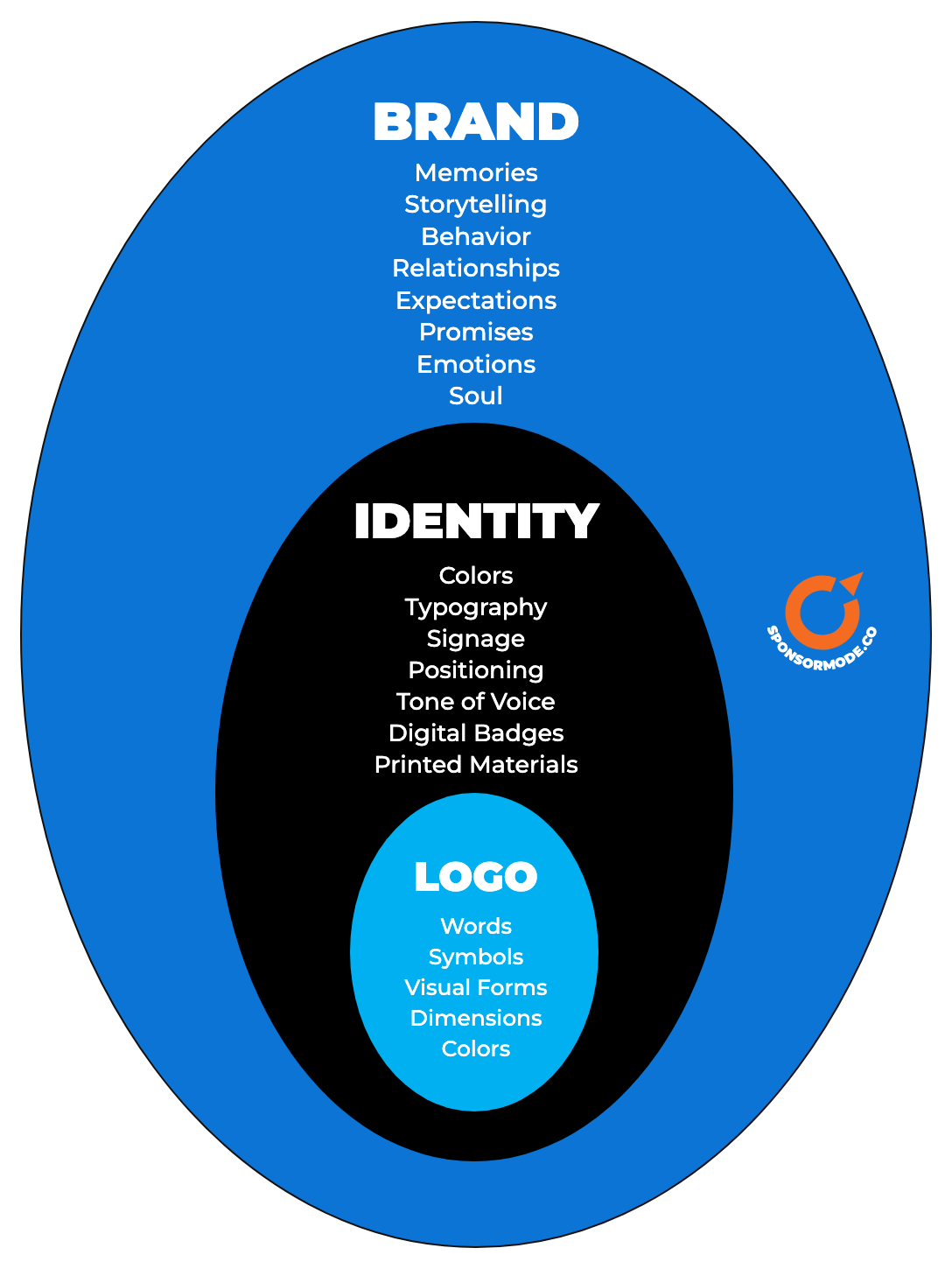
Sponsormode™’s creative question is: after seeing the logo, what can a fan experience with the brand? A useful stadium service, relevant content or a recurring benefit can give the sponsor’s presence meaning.
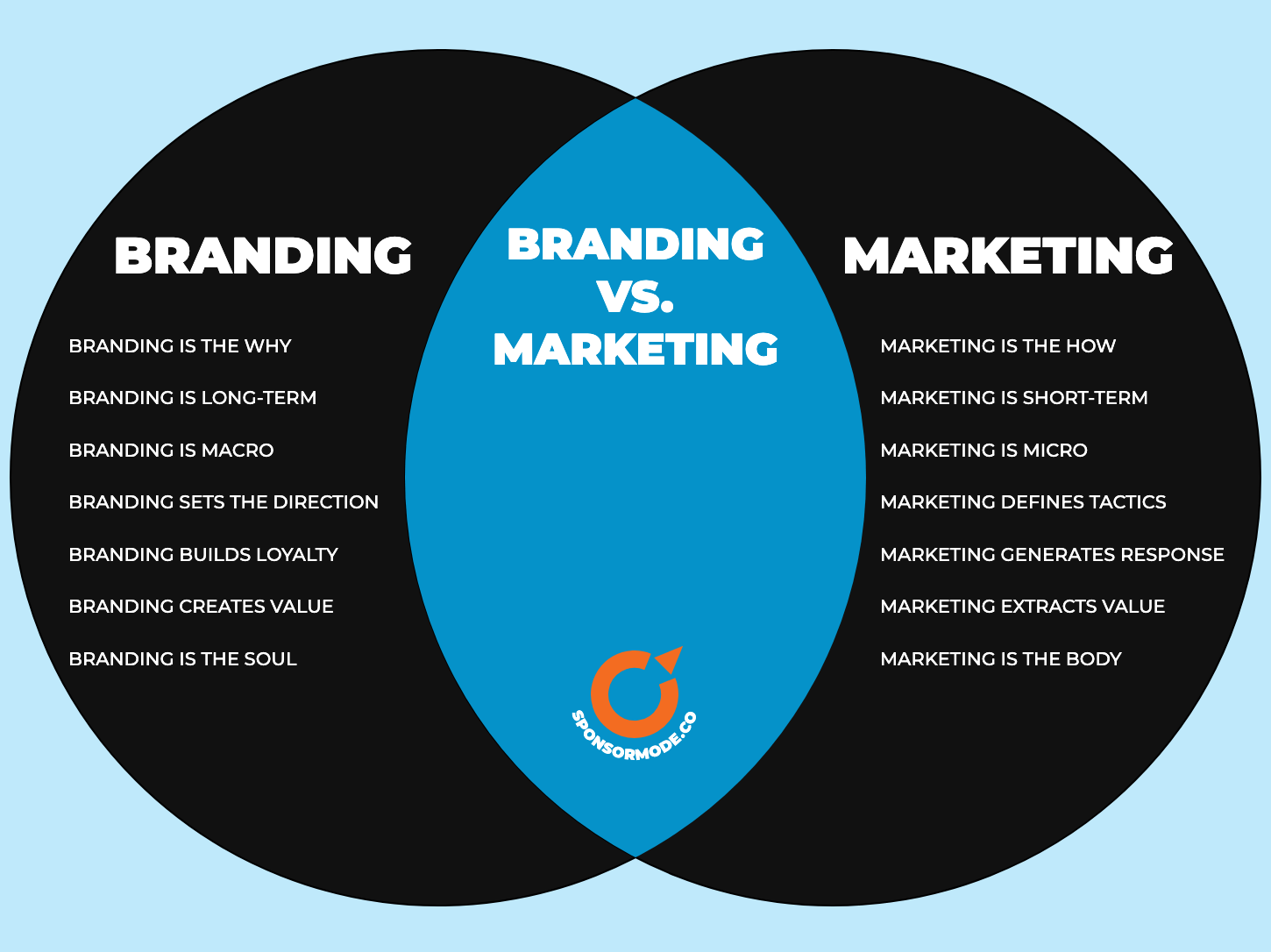
Nielsen discusses brand equity and sales impact as dimensions of sponsorship evaluation. Source: Nielsen, The Changing Value of Sponsorship, 2021.
How do you measure sponsorship returns beyond exposure?
In plain language
Measuring sponsorship returns means finding out what the partnership helped change. Imagine a sneaker brand sponsoring a club. Many people saw its logo. But did they get to know the brand better? Consider trying its sneakers? Buy because of its connection with the club?
Each question needs a different way to track the result: asking people, counting product trials or investigating sales. First, choose what you want to achieve. Then look for evidence that you are getting there.
Technical explanation
Measuring sponsorship returns beyond exposure means linking the sponsor’s objective to indicators of perception, behavior and economic outcomes. Start by defining what should change, for which audience, over what period and against which baseline.
As a practical application, a brand seeking consideration can track brand research; one seeking trial can measure benefit usage; and one seeking acquisition can track new customers and incremental contribution margin. These measures are not interchangeable.
AMEC’s framework distinguishes outputs, audience responses, outcomes and impact. It supports this separation, but is not a sponsorship-specific financial ROI method. Source: AMEC Integrated Evaluation Framework.
How do you calculate financial sponsorship ROI?
In plain language
ROI means “return on investment.” It helps answer: how much money did the activity bring back after accounting for what it cost?
Imagine this example: a brand spent $100 on a sponsorship, including everything needed to put it into practice. The extra sales generated by the activity left $150 after paying the costs of the products sold, but before deducting that $100. Deduct it, and $50 remains: ROI is 50%. Each $1 invested produced $0.50 in gain beyond recovering the investment.
The challenge is finding out which sales were truly additional. Some people might have bought anyway. That is why sales revenue is not the same as money gained because of the activity.
Technical explanation
Financial sponsorship ROI compares estimated incremental economic gain with the total investment required to generate it. The measurement convention proposed here is:
ROI (%) = [(incremental contribution margin before sponsorship costs − total sponsorship investment) ÷ total sponsorship investment] × 100.
Investment should include the relevant rights fees, activation, production, media, operations and measurement costs for the period. Incremental contribution margin should deduct variable costs associated with additional sales, without deducting costs included in the investment twice.
Hypothetical example: $150,000 in incremental contribution margin before sponsorship costs and $100,000 in investment produce 50% ROI. $150,000 in revenue alone does not establish that result. Without a defensible estimate of incrementality, present the calculation as a scenario rather than proven ROI.
Background on observed conversions versus causal effects: Google Ads, About Conversion Lift. The formula above is an explicit financial convention for this content, not a sponsorship formula published by Google.
What is the difference between attribution and incrementality?
In plain language
Imagine buying sneakers with a coupon from your club. The store can connect your purchase to the coupon. That connection helps give the activity credit: this is attribution.
Now ask another question: would you have bought the sneakers without the coupon? If so, it was not necessarily an extra sale. If the activity made you buy something you otherwise would not have bought, it created an additional result. Incrementality tries to find out how much of that happened.
We cannot observe the same person both buying and not buying in the same situation. Comparing similar groups with and without the activity helps estimate what it actually added.
Technical explanation
Attribution allocates credit for a conversion across touchpoints. Incrementality estimates what happened because of an activity and would not have happened without it.
A coupon can identify a sale associated with an activation. It does not prove that the customer would otherwise have made no purchase. To investigate additional effects, a test can compare eligible groups, ideally randomly assigned, with and without the activity.
Google describes Conversion Lift tests using treatment and control groups. Applying that principle to sponsorship requires a suitable research design; the advertising tool does not automatically measure an entire partnership. Source: Google Ads, About Conversion Lift.
How can a club increase the value of sponsorship packages it has already sold?
A club can develop the value of existing sponsorship packages by improving the use of contracted rights, the relevance of experiences and the evidence of outcomes for each sponsor. Improving delivery does not automatically increase the price of an existing agreement.
We recommend five steps: review rights and delivery; identify underused assets; select opportunities connected to the brand’s objective; agree on execution and measurement; and discuss findings in partnership reviews. Additional activities must respect the agreed scope.
Hypothetical example: develop a standalone hospitality activity into a sequence of B2B meetings with qualified guests, commercial follow-up and recorded opportunities.
Nielsen presents property and asset analysis as support for sponsorship packaging. The process above is Sponsormode™’s editorial recommendation. Source: Nielsen Impact Score Pro.
How can sponsors collaborate without creating brand conflicts?
Sponsor collaboration requires a useful opportunity for fans, compatible brands and agreement on responsibilities, rights and measurement. Appearing on the same shirt does not, by itself, create collaboration.
One possible design connects transportation, food and payment services within a matchday journey. Each brand needs to understand its role, cost, contribution and outcome. Exclusivities and permissions should be checked before execution; commercial collaboration does not presume the sharing of personal databases.
This is a partnership design recommendation. The ICC Code provides a conduct reference for sponsorship, including relationships among sponsors and audiences. Source: ICC, 2024 Code, Chapter B.
What is the Cross-Sponsor Conversion Rate?
In plain language
This rate shows how many people move from one sponsor’s activity to a defined action with another sponsor connected to it.
Imagine a transportation brand and a sandwich shop sponsoring the same club. During the transportation brand’s activity, 100 fans see an offer from the sandwich shop. Ten of those same people use the offer to buy a sandwich within the agreed period. In this hypothetical example, the rate is 10%: 10 out of every 100 people.
“Conversion” means the action we want to track: a purchase, a sign-up or another action defined before the campaign. “Cross-sponsor” means the journey connects two sponsors.
The rate shows what happened within that connection. On its own, it does not prove that people bought only because of the offer or show how much money the partnership earned.
Technical explanation
The Cross-Sponsor Conversion Rate measures the proportion of participants in a journey connected to sponsor A who complete a defined action with sponsor B after receiving a trackable opportunity within that journey, during a specified period.
CSCR A→B (%) = unique eligible participants from A exposed to B’s opportunity who convert with B ÷ unique eligible participants from A exposed to B’s opportunity × 100.
Hypothetical example: 1,000 eligible participants receive a trackable offer from B in A’s journey; 80 complete the defined purchase within 30 days. CSCR A→B is 8%.
This definition is a proposed Sponsormode™ methodology, not a validated industry standard. A→B and B→A are different measures. The rate describes observed conversion; it does not prove incremental impact or ROI.
Conceptual background for this limitation: Google Ads, incremental versus attributed conversions. The source does not define or endorse CSCR.
How do you measure the Cross-Sponsor Conversion Rate in practice?
In plain language
Track two numbers: how many people saw the second sponsor’s opportunity and how many of those same people completed the intended action within the agreed period.
For the sandwich shop example:
- Define what counts: buying a sandwich using the offer within 30 days.
- Record how many fans in the first sponsor’s activity actually saw the offer.
- Use a trackable link or code to identify which of those people bought.
- Count each person once, even if they buy more than once.
- Divide the number of buyers by the number of people who saw the offer, then multiply by 100.
If 10 of the 100 people bought: 10 ÷ 100 × 100 = 10%. This is a hypothetical example, not a universal target.
Sending an offer does not guarantee someone saw it. If we cannot measure who saw it or connect purchases to that group, we lack the data to calculate the rate reliably.
Technical explanation
To measure CSCR, define sponsor A as the origin, sponsor B as the destination, the eligible population, recorded exposure to the opportunity, the conversion action and the observation window before launching the activation.
Sponsormode™’s proposed protocol requires:
- A trackable record of B’s opportunity being presented in A’s journey; delivery alone does not necessarily establish exposure.
- Unique-person counting, deduplication and documented treatment of cancellations and returns.
- A numerator containing only people included in the denominator; repeat purchases do not multiply converted participants.
- A fixed window, such as 30 days after first valid exposure, with complete cohort follow-up.
- Separation of new and existing customers when acquisition is the objective.
- A “not calculable” result when the denominator is zero or cannot be measured reliably.
Use links, codes or integrations consistent with the activation’s data governance. Report counts alongside rates and disclose tracking gaps. An average of A→B rates does not automatically represent ecosystem conversion: overlapping audiences require deduplication.
Definition and protocol source: proposed Sponsormode™ methodology, version 1.0. This material adopts no external numerical benchmark.
Who is a fan, and how can sponsorship connect with their life throughout all 365 days of the year?
A fan can be a supporter who follows a team or someone who identifies with its products, style, history and culture, even without ever visiting a stadium. That relationship can exist throughout all 365 days of the year and develop through fashion, entertainment, communities and everyday experiences.
Imagine someone wearing a club shirt because they like its design, the people wearing it or what the brand represents. That person can develop a connection with the club without following its results or even having watched a match. Buying a product does not automatically make someone a fan; the connection develops through identification, interest or belonging.
Paris Saint-Germain helps illustrate this reach. Beyond Paris, the club has official stores in New York City, Tokyo, London, Qatar and Hong Kong. Its international presence also draws on the connection between sport, culture and fashion. Like other major clubs, PSG has supporters and fans around the world whose connection with the club can develop far beyond the stands. This creates opportunities for someone to discover and connect with PSG through a store or collection, even without having visited France. Source: PSG official stores.
For Sponsormode™, the fan journey includes the different ways a person discovers, experiences and brings a club’s world into their life. It can begin with a shop window, a video, a fashion collaboration, a conversation with friends or a cultural experience.
Sponsorship can contribute to these relationships through relevant products, services, content and experiences throughout the year. Planning identifies these audiences, what connects them to the club, where that connection happens and how each sponsor can contribute.
The goal is to build a meaningful brand presence in people’s lives. Every activity should have a clear fan benefit, an owner responsible for delivery and a way to track its outcome.
PSG documents the stores referenced above. The example of someone connecting with a club without watching matches illustrates a possibility within this approach, rather than making a claim about every store customer’s history.
What is Creative Sponsorship Architecture?
Creative Sponsorship Architecture is Sponsormode™’s approach to organizing rights, brands, experiences and touchpoints into a connected, measurable sponsorship system. Human creativity directs the relationships; AI supports research, synthesis and hypothesis development, with human review.
In practice, the architecture defines what to connect, why that connection matters to fans and brands, who executes it and how outcomes will be assessed. Its purpose is to turn scattered opportunities into a coherent plan.
Source: Sponsormode™ institutional definition.
What is ROADMAP-90 and what is it for?
ROADMAP-90 is Sponsormode™’s 90-day action plan for using sponsorship as a marketing and brand management tool and developing the sponsorship ecosystem. It starts from the answers to the free Diagnostic, which assesses sponsorship across five dimensions, and from the circumstances of each business or sports organization.
In plain language, it is a guide to what to do with sponsorship opportunities, where to start and how each action can contribute to the organization’s goals.
The plan sets out 10 prioritized actions, organized into three 30-day phases:
- Days 1–30 — Align and prepare: learn each sponsor’s commercial objectives, map the assets and define how to measure.
- Days 31–60 — Activate and connect: launch pilots, connect different sponsors’ activations and prepare proposals.
- Days 61–90 — Prove and reprice (for sponsor brands, prove and optimize): gather results, support renewals and decide what to expand, adjust or end.
Each action carries an indicator and a baseline, and the plan includes reviews at days 30, 60 and 90. Across the actions, the work can optimize assets already in operation, connect assets where there is synergy and uncover new assets from existing ones.
For example, a gathering with former players could become the starting point for a storytelling series, a parent-and-child experience and a joint sponsor activity. These possibilities depend on available rights, audience relevance and execution capacity.
Product definition source: Sponsormode™. The example is hypothetical. AMEC provides an external reference for connecting objectives with evaluation, not for defining or validating ROADMAP-90.
See also the sponsorship glossary.